

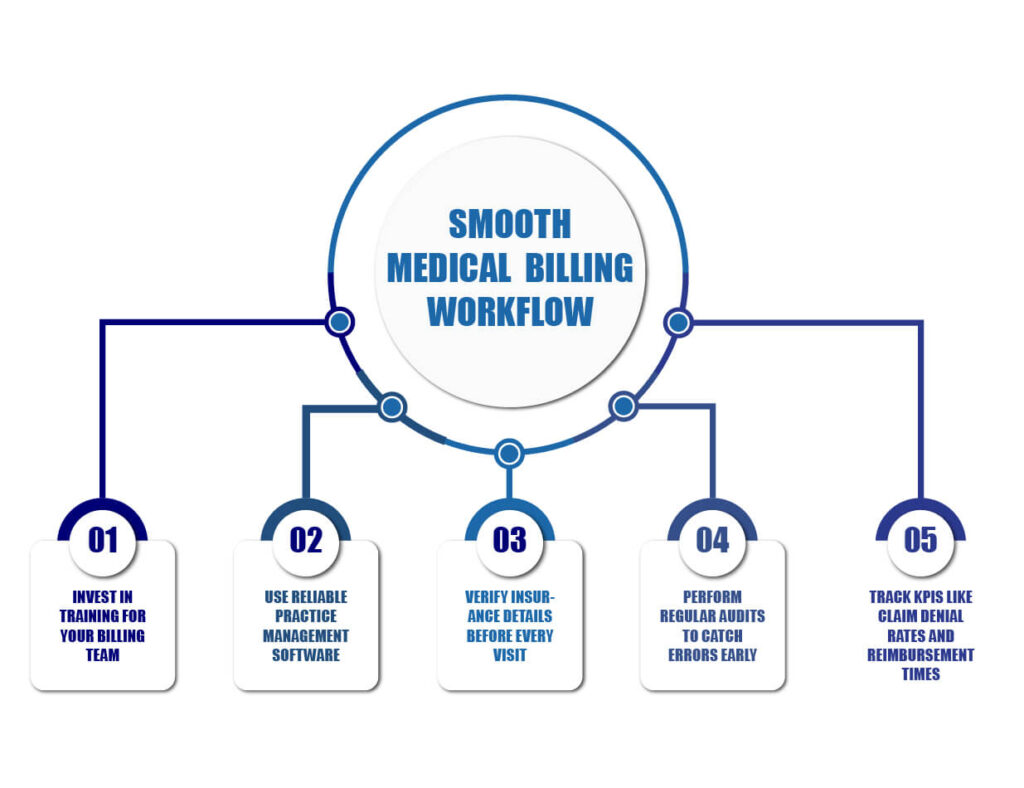

Here’s a useful diagnostic for any inpatient billing operation: trace the path of a single claim from the moment care is delivered to the moment payment lands in accounts receivable. Count every system touched, every manual handoff made, every point where the process could stall. Most billing administrators doing this exercise for the first time are surprised by how many steps there are, and how many of those steps introduce real risk.
A well-designed medical billing workflow eliminates unnecessary risk at every stage, not by simplifying the clinical reality of inpatient care, but by creating clear, consistent processes that move accurate information through the system without depending on any single person’s memory or initiative.
Why Most Billing Workflows Start in the Wrong Place
The most common mistake in billing workflow design is treating claim submission as the starting point. It isn’t. The true foundation is charge capture, the systematic documentation of every billable service provided to a patient. Every error, omission, or ambiguity introduced at the charge capture stage travels forward through the entire workflow, compounding in the form of denials, resubmissions, and delayed payments.
Optimizing charge capture first, before addressing any other step, creates a cleaner foundation that makes every subsequent stage more efficient. Skipping this and diving straight into claims management means continuously patching downstream problems that originate upstream.
The Seven Steps That Define an Optimized Workflow
Charge capture forms step one: documenting every service, procedure, and supply used in patient care with accurate CPT codes, correct ICD-10 diagnoses, and smooth integration with EHR systems. Incomplete or delayed charge capture at this stage means money that is earned but never billed.
Claim submission follows: using electronic processing with real-time eligibility verification and claim scrubbing to catch errors before they reach payers. Clean submissions produce faster payment and dramatically fewer rejections.
Payment posting comes next: recording all payments, adjustments, and contractual allowances accurately to maintain visibility into actual collections. Delayed or incorrect payment posting obscures underpayments and billing errors that could otherwise be caught and corrected.
Accounts receivable management tracks outstanding claims and follows up on anything aging beyond expected timelines. Ignoring AR management is how outstanding balances quietly convert into write-offs.
Denial management converts rejected claims from losses into recovery opportunities. Digging into denial reasons, correcting issues, and resubmitting with proper documentation recovers revenue that would otherwise simply disappear.
Patient billing and collections handles the direct patient-facing side, sending clear statements and offering payment options that make it easy for patients to pay what they owe without confusion or friction.
Team support and communication, often undervalued as a workflow component, ensures that clinical and billing teams share information efficiently within integrated systems rather than relying on informal handoffs that create delays and gaps.
Where Workflows Tend to Break Down
Three points generate most billing workflow failures consistently. Documentation that doesn’t travel cleanly from provider to coder, whether because of system disconnects, inconsistent documentation habits, or delayed charge entry, creates errors that require expensive rework later. Manual processes at high-volume stages introduce fatigue-driven errors that automated tools eliminate entirely. And siloed departments that don’t communicate well allow problems to persist undetected across billing cycles.
The Role of Regular Auditing
Revenue cycle audits, conducted quarterly on specific workflow components rather than as an annual comprehensive exercise, identify inefficiencies before they compound into larger revenue problems. Examining charge capture accuracy, denial patterns, and collection rates on a rolling basis gives billing leadership an ongoing view of process health rather than a snapshot of damage already done.
Quarterly audits consistently surface improvement opportunities that monthly reports obscure: recurring denial reasons tied to specific payers, coding inconsistencies concentrated around particular encounter types, and AR aging patterns that point to specific workflow bottlenecks.
Automation as a Multiplier
The workflows that perform best are the ones that automate the highest-volume, most repetitive steps: charge capture review, claim scrubbing, denial tracking, payment posting, and KPI reporting. Automation handles these tasks with better consistency than manual processes and frees billing staff to focus on the work that genuinely requires human judgment, complex denials, unusual coding scenarios, and accounts requiring direct follow-up.
AI-powered charge capture that reads clinical notes and extracts billable information directly can improve coding accuracy by meaningful margins, which reduces denials and decreases the volume of rework that slows every subsequent workflow stage. The cumulative effect is a billing operation that earns more per encounter and spends less administrative time per dollar collected.