

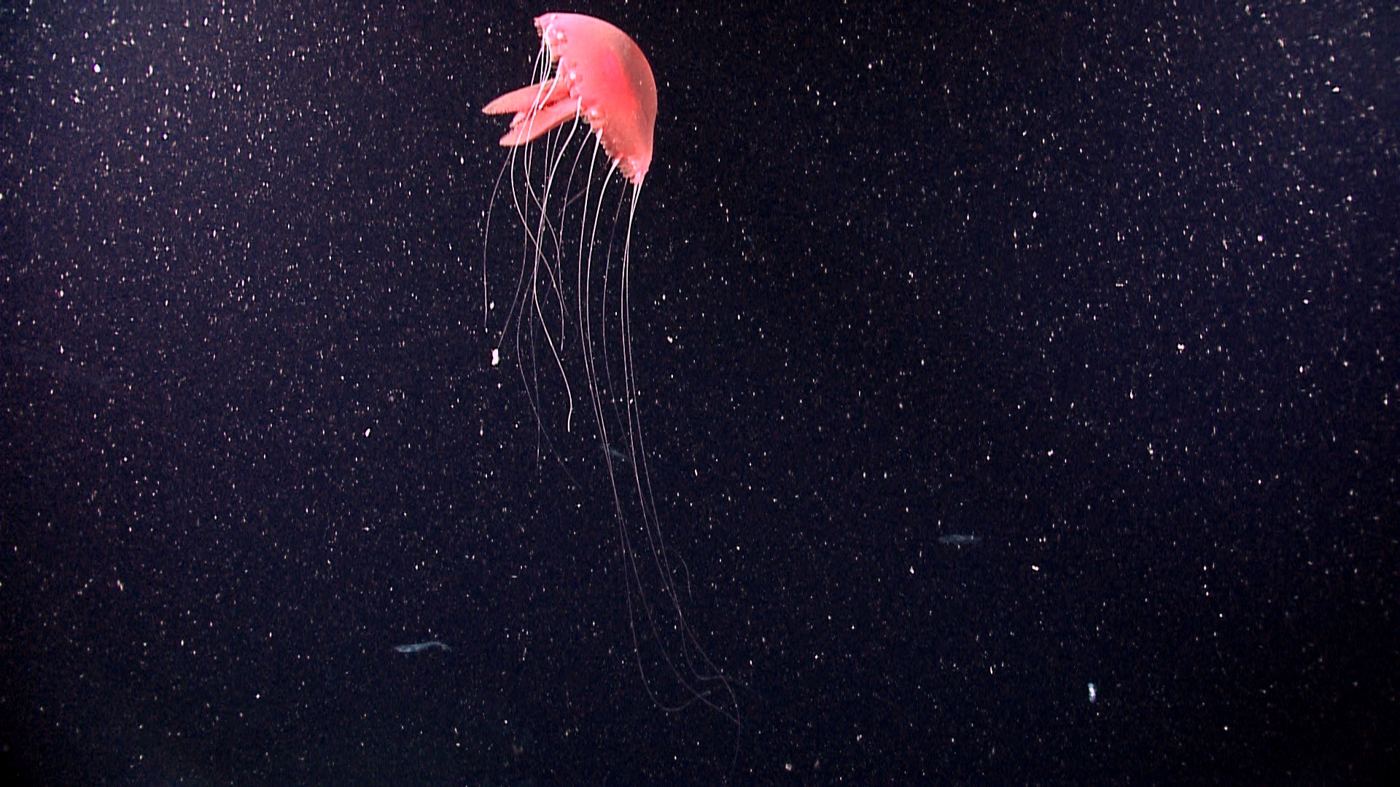

More people have travelled to space than to the deepest parts of Earth’s oceans, and every serious expedition there seems to return with creatures science has never catalogued. In recent missions, remotely operated vehicles have filmed translucent fish, ghostly octopuses and entire gardens of sponges thriving kilometres below sunlight, in crushing pressure and near-freezing water. Biologists estimate that a large share of ocean species remains undescribed, which makes each dive a genuine voyage of discovery.
Life Where Life Seems Impossible
The deep sea was once assumed to be a near-empty desert. Instead, researchers find ecosystems built on surprising foundations: marine snow drifting from above, whale carcasses that feed communities for decades, and hydrothermal vents where microbes harvest chemicals instead of sunlight. Reporting from Nature News describes species with antifreeze-like proteins, enormous lifespans and bioluminescent signals whose purposes scientists are only beginning to decode.
New tools drive the discovery rate. Autonomous submersibles map terrain, environmental DNA sampling identifies species from a bottle of seawater, and high-definition cameras record behaviour that nets and dredges destroyed. Our science desk follows these missions because they rewrite textbooks: creatures once thought rare turn out to be abundant, and food webs prove stranger and more connected than models assumed.
Why the Deep Ocean Matters Now
Interest is not purely scientific. Mining companies eye mineral-rich nodules on abyssal plains, fishing fleets push into deeper water, and climate researchers track how the deep ocean absorbs heat and carbon. Decisions about all three are being made with incomplete knowledge of what lives there, which is why many scientists argue for mapping and protecting representative deep-sea regions before industrial activity expands, a position outlined by ocean programmes at NASA and partner institutes studying Earth systems.
Each new species is both a discovery and an argument: evolution, given time and an extreme environment, produces solutions no engineer would imagine. Some may inspire medicines, materials or sensors; all of them expand the known story of life on Earth. The deep ocean remains our planet’s largest habitat and least understood frontier — and its exploration era is only just beginning.
The economics of deep-sea discovery have changed alongside the technology. A single research cruise can cost millions, so expeditions are planned like space missions, with international teams sharing ship time and data openly to multiply the science each dive produces. Pharmaceutical researchers screen deep-sea organisms for compounds unlike anything on land, while geologists read the sediments for records of past climates that ice cores cannot reach. Even the fishing industry watches, because nursery habitats identified in deep water shape the quotas that sustain coastal livelihoods. Few frontiers reward so many different kinds of curiosity at once, which is why ocean nations are racing to map their seabeds completely.
Public fascination follows the science closely, with livestreamed dives drawing millions of viewers who name new creatures and follow individual octopuses like characters in a series. That attention matters for funding and conservation alike. A habitat nobody sees is hard to protect; a habitat watched by the world gains defenders. The cameras exploring the abyss may prove as important as the specimens they find.