
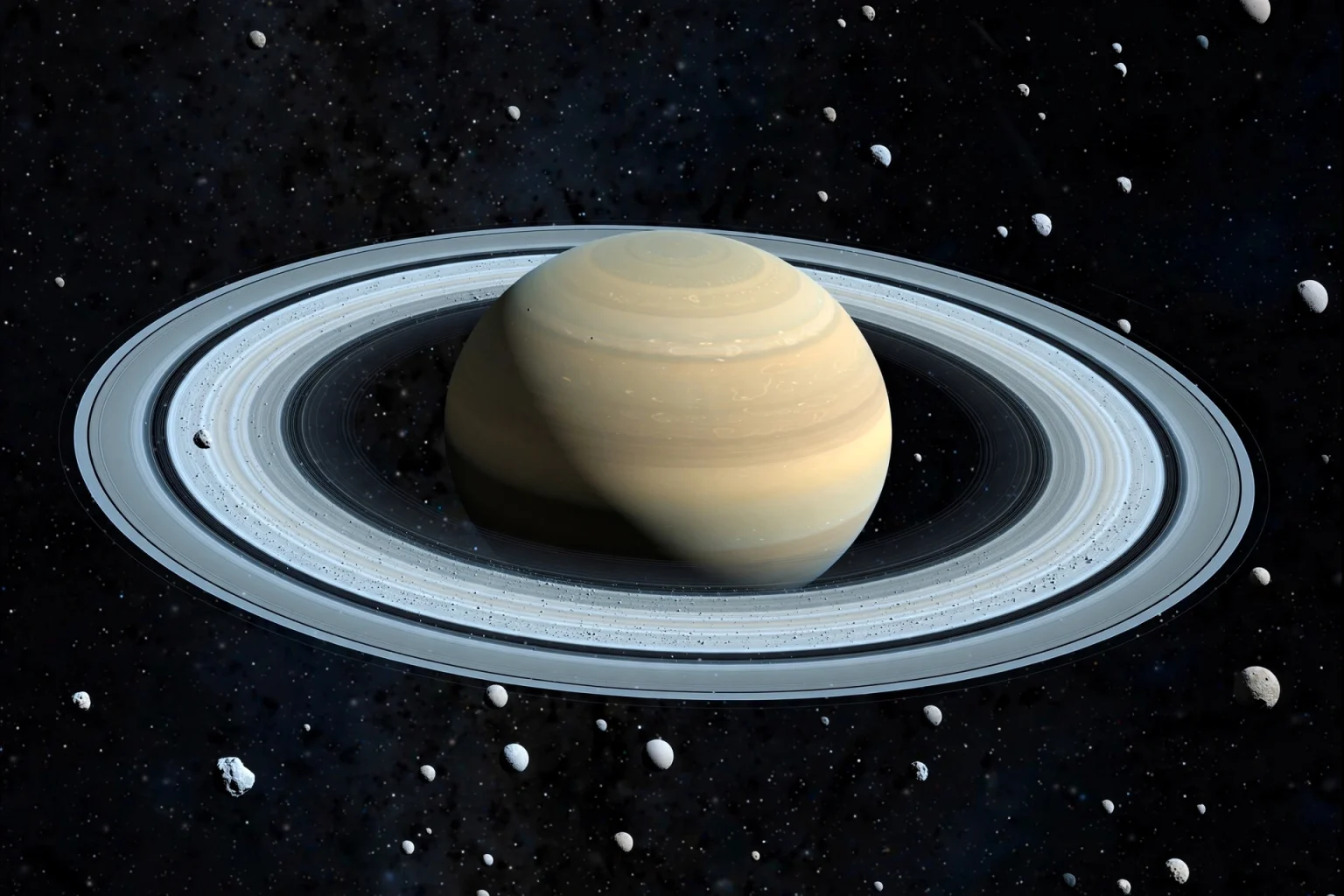

Saturn’s claim to the title of the solar system’s moon king is no longer in serious dispute. Astronomers have confirmed 128 new moons of the ringed planet, taking its total to 274 satellites — a tally that leaves Jupiter, with 95, far behind and sets a record unlikely to be challenged by any other planet.
The announcement follows years of observation with the Canada-France-Hawaii Telescope and formal recognition by the International Astronomical Union. The new moons are irregular satellites: small, dark bodies, mostly a few kilometres in diameter, that orbit Saturn at great distances on tilted, elongated paths.
From faint smudges to official moons
Detecting objects so small and distant pushes ground-based astronomy to its limits. The survey team stacked sequences of long-exposure images along Saturn’s trajectory, a method that allows moons too faint to register individually to build into detectable points of light.
Candidates then faced a long probation. Astronomers at the University of British Columbia tracked them across observing seasons until their orbits were established beyond doubt — the standard the IAU requires before a satellite is named in the official record.
The contrast with more immediate spectacles, such as a SpaceX launch that created a jellyfish cloud over the East Coast, is striking: this story unfolded at the pace of orbital mechanics, not news cycles.
Clues written in rubble
What excites planetary scientists is not the record but the evidence the moons carry. Irregular moons are thought to be captured asteroids or the remnants of larger bodies broken apart by collisions. They travel in families sharing similar orbits, and each family’s membership and spread encode the time and violence of its creation.
Adding 128 members refines those reconstructions considerably. Some families may turn out to be younger than assumed, hinting that the Saturn system remained a hazardous, collision-prone place long after the planet itself formed.
The census continues
Astronomers caution that the standings reflect detection thresholds as much as reality. Both giant planets are believed to host thousands of still-undiscovered small moons, and deeper surveys planned for this decade will find more of them.
For the record books, however, the present position is unambiguous. With 274 confirmed satellites, Saturn wears the crown — and on current form, it is pulling away.
Names, numbers and the human side of the catalogue
For now, most of the new moons carry only provisional designations — strings of letters and numbers that record when and where they were found. Names come later, and for Saturn’s irregular moons they follow themes drawn from mythology: Norse, Inuit and Gallic traditions supply the names for the planet’s three great families of captured moons, continuing a convention that has given the outer solar system some of its most evocative labels.
The naming process is unhurried and occasionally contested, but it reflects something genuine about the catalogue’s growth. Each moon that graduates from a designation to a name has passed fully from detection into knowledge: observed across years, its orbit secure, its existence no longer provisional in any sense.
Behind the statistics stand the observers themselves — small teams who requested telescope time, wrote the stacking software, and spent seasons recovering objects that a single cloudy night could misplace. Records in astronomy are often credited to instruments, and the Canada-France-Hawaii Telescope deserves its share. But 274 is also a number assembled by persistence, and it is worth saying so while the ink on the record is still fresh.
For amateur astronomers, the new moons themselves will remain far beyond the reach of backyard telescopes; even Saturn’s largest irregular satellites demand professional instruments. But the planet itself, with its rings and its giant moon Titan, is entering a favourable season for observation, and skywatchers turning a small telescope towards it this autumn will be looking at a system now known to hold 274 worlds. The figure lends a certain pleasure to the view: almost everything that makes Saturn remarkable is, even now, still being counted.