

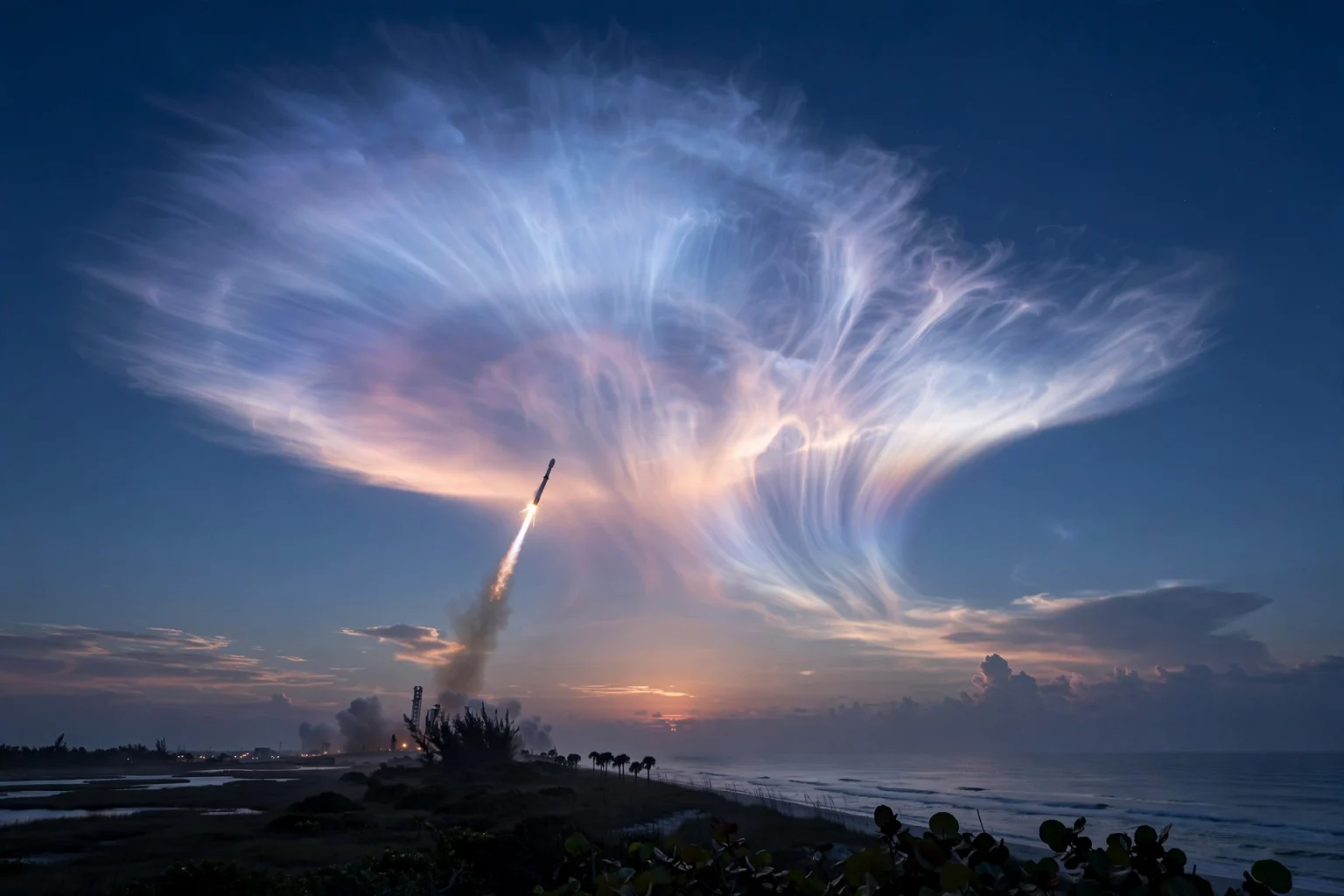

Early risers along the United States East Coast were treated to an unusual sight in the twilight sky this week, when a SpaceX rocket launch created a glowing, billowing formation widely described as a jellyfish cloud. Photographs shared from Florida to the mid-Atlantic showed a bright, expanding plume with trailing tendrils, lit up against a still-dark sky while the ground below remained in shadow.
The spectacle, reported by The Guardian in its coverage of the launch, quickly became one of the most talked-about sky events of the week. For many observers it looked like something from a science-fiction film. For scientists and experienced launch watchers, it was a familiar, if still breathtaking, example of what happens when rocket exhaust meets sunlight at high altitude.
What Creates a Jellyfish Cloud?
The effect occurs when a rocket climbs into the upper atmosphere shortly before sunrise or just after sunset. At ground level, the sky may still look dark, but tens of kilometres above the surface the exhaust plume is already catching direct sunlight. That contrast is what makes the plume glow so dramatically.
As the rocket gains altitude, the surrounding air pressure falls and the exhaust expands far more widely than it would near the ground. Water vapour in the plume can freeze into tiny ice crystals, which scatter the sunlight and give the cloud its soft, luminous edges. The result is a rounded head with long, wispy streamers underneath, closely resembling a jellyfish drifting through the sky.
Launch watchers on the East Coast have a particularly good view of this phenomenon when rockets lift off from Florida on north-easterly trajectories. The same geography that makes the region a busy corridor for orbital launches also makes it one of the best places in the country to witness twilight phenomena.
Why This Launch Drew So Much Attention
Not every launch produces such a clear display. Timing, weather and trajectory all have to align. A few minutes earlier or later, and the plume may be too dim or too fully lit to stand out. Clear skies along a long stretch of coastline helped this time, allowing people hundreds of miles apart to photograph the same formation from very different angles.
Social media amplified the moment. Within minutes, images were circulating widely, with many first-time viewers asking whether they had seen a comet, a meteor or something unexplained. Local newsrooms fielded calls and messages from readers, a reminder of how powerful a shared public moment can be. Our recent reporting on local journalism’s quiet comeback explored how exactly these kinds of community moments are helping smaller newsrooms win readers back.
A Busier Sky, and More Chances to See It
Launches from the Florida space coast have become far more frequent in recent years, driven largely by commercial satellite deployments. That higher cadence means twilight phenomena, sonic booms and bright re-entries are no longer rare novelties for coastal residents. They are becoming a regular feature of life along the space coast, and increasingly, a draw for visitors who time trips around launch schedules.
That growing familiarity cuts both ways. Regular watchers now know to check launch windows and weather forecasts, and photography groups plan outings around promising twilight liftoffs. At the same time, astronomers continue to raise questions about light pollution, satellite brightness and the cumulative effect of a busier orbital environment on ground-based observation.
How to Catch the Next One
If you want to see a jellyfish cloud for yourself, experts suggest watching for launches scheduled in the hour before sunrise or the hour after sunset, choosing a location with a clear view toward the launch site, and giving your eyes several minutes to adjust to the dark. Binoculars can reveal structure in the plume, but the display is easily visible to the naked eye when conditions are right.
Above all, be patient and be ready. The most striking part of the display can develop quickly as the rocket climbs, and it may fade within minutes as the exhaust disperses. As this week’s reaction showed, those few minutes can be enough to stop traffic, fill phone galleries and remind an entire coastline to look up.